Life Revisited
An Excerpt From Chapter 2
A Fifteen Year Old Runaway
I was terrified and poorly equipped to hitchhike and camp out in the Santa Cruz Mountains and San Francisco Bay Area. It was the spring of 1972. I had only a few dollars and no idea where I was going or what I was doing, but most of all I didn’t know much about people.
A 15-year-old girl who’d been guarded and constrained all her life, as shy and inhibited as a person could be, I put out my thumb and got into cars with strangers.
Other hitchhikers taught me how to get spare change and find good places to sleep. Once, a few weeks after ran away, I was with people in the back of a pickup truck when a cop pulled us over outside a commune in Marin County, north of San Francisco. I was terrified. I didn’t want to get arrested because I was afraid to go home. The other people told me not to be scared. “Don’t talk too much. You know, be cool. Look him in the eye.”
The cop started checking IDs. Standing there with my long brown hair, dirty clothes, and rolled-up blanket, I tried to figure out what to say. I didn’t have a license and wasn’t even old enough to get one.
“How old are you?” was the first thing he asked.
“Eighteen.”
“Uh-huh. What’s your name?”
I didn’t decide for sure until the words came out of my mouth. “Maria Draper,” I said. Maria for my favorite aunt and Draper for Kathy, who’d helped me run away.
“Show me your driver’s license.”
“It was in my bag. Someone stole it.”
“Uh-huh. Where do you live? Where’re you going?”
He asked more questions. I was either convincing enough that he didn’t arrest me, or maybe he decided I wasn’t worth the paperwork.
That was the first time I completely got away with defying authority. I found it rather satisfying.
My Lack of Identity
There’s no first name on my birth certificate, which made it easier for the fifteen-year-old me to build an identity after I ran away from home. Government bureaucracy in the 1970s was considerably laxer than it’s come to be. The document lists my father’s birthplace as West Virginia; Mom’s as The Philippine Islands. When I was born, Theodore Roosevelt Barrs, Jr. was twenty-seven and Nieva Icasiano Barrs was twenty-four. I was their fourth baby, with nine more to come.
The space for my first name is blank. I was stunned the first time I saw it, when I needed it to get a driver’s license. It brought back the memory of a former neighbor. We lived in South San Francisco then, above our printing business, so I was between five and eleven when she visited.
I came downstairs while Mom and the neighbor were talking. The lady said, “Oh, Lyn. You were such a cute baby! Look at you, so big now.”
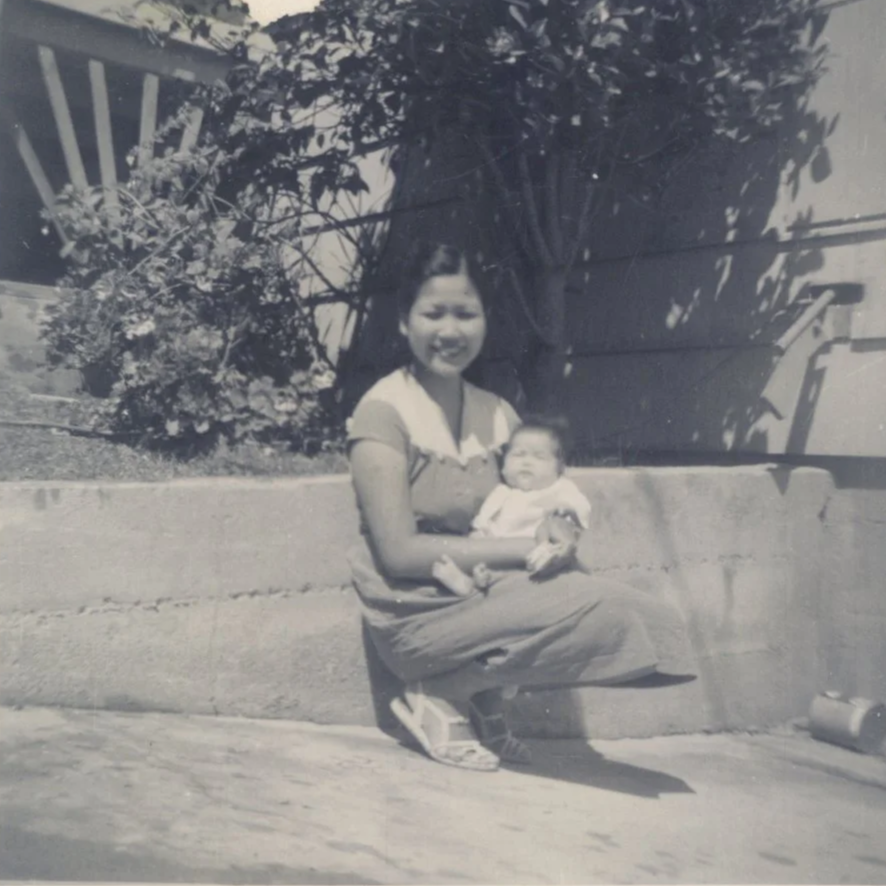
My mom and I, shortly after I was born.
I didn’t know what to say so I didn’t say anything.
“I lived next door when you were born,” she said. “I remember your daddy wanted to name you after your mom, but she didn’t want that. Did you know you still didn’t have a name when you came home from the hospital?”
No, I didn’t know that. Why didn’t Mom want me to have her name? Did that mean she didn’t want me? Mom’s name, Nieva, means snow in the Philippines. Dad and other people called her Evi. They ended up naming me Evelyn.
I hated that name.
I didn’t know any other Evelyns, and people said it wrong, like Evvv-lyn without the middle uh. I hated it even more after what that lady told me. Our Catholic school class once had to write about the saints we were named after. I couldn’t find anything about a St. Evelyn. The list of names in the back of our family bible said Evelyn was “the masculine form of Helen.” Why did they give me a boy’s name?
I made up a story about a St. Evelyn who gave baskets of food to the poor.
My family called me Lyn. I never told them that at school I started adding another ‘n’ to make it prettier.
Adult Reflections
As an adult I know now that Mom was being her usual modest self when she didn’t want me to have her name, or perhaps she thought it wasn’t ‘American’ enough. Or both. I’ve wondered what I would call myself now, if that neighbor hadn’t stopped by.
Decades later, Mom told me how happy she and Dad were to finally find the name Evelyn, which included her name, Evi. The way she told it, it was a beautiful part of my parents’ love story, how they wanted to find the perfect name for their first daughter. She described them leaving the hospital, excited about having a girl after three boys, still talking about what to call me. When Mom told me about choosing ‘Evelyn’ as my name, we were standing at my sister Teresa’s grave in Seaside, CA.
We cried a lot that day.